Round
 Organic Round
 Square
 Danish Oval Straight
 Danish Oval Round
 Half Oval
 Rectangular
 Pebble
 Live Edge
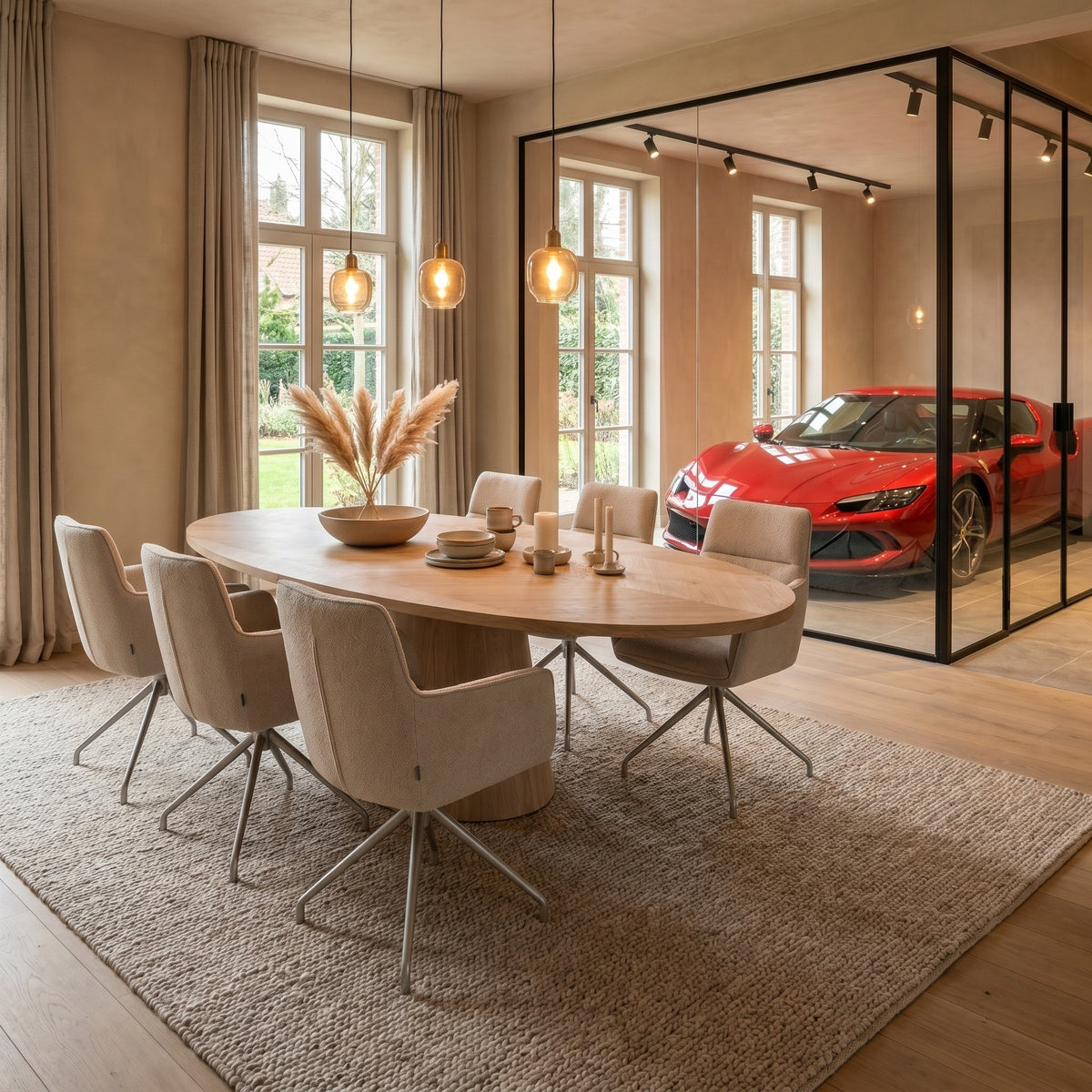
Herringbone dining table: what is it and why is it so popular?
The herringbone pattern shows up everywhere in interiors - from floors and kitchen tiles to the dining table as the centrepiece of your dining room. But what makes a herringbone dining table so special, and why are more and more people choosing this classic pattern for their tabletop?
What is a herringbone dining table?
On a herringbone dining table, the top is built from solid oak planks laid in a V shape - always two planks facing each other diagonally, creating a zigzag pattern that resembles the bones of a fish. Hence the name.
The pattern has been around for centuries: the Romans used it in their road construction and floors. In the Netherlands and Belgium it appeared in the historic parquet floors of townhouses and manor houses. That rich history makes herringbone sought after again today - it feels both timeless and modern.
What sets a herringbone tabletop apart from an ordinary solid oak tabletop is the visual movement. Thanks to the diagonal direction of the planks, the top looks wider, livelier and more interesting - without looking busy. The wood shows off its character more than when the planks simply lie side by side.
Why is the herringbone pattern so popular?
The popularity of the herringbone dining table is no coincidence. There are several reasons why this pattern has grown so strongly over the past decade:
1. It suits almost any interior
Industrial, Japandi, Scandinavian, modern country - the herringbone pattern fits them all. The warm oak combines seamlessly with a steel frame for an industrial look, or with a wooden leg for a more organic feel. The geometry of the pattern gives just enough structure to make a neutral dining room feel special.
2. Solid oak with character
A herringbone tabletop is always made of solid wood - thin veneers or chipboard are technically not suited to this pattern. That means you automatically choose a table that lasts for decades, that you can sand and re-oil, and that gets more beautiful with the years. The grain of the oak crosses in the pattern in a way that makes every table unique.
3. A statement without shouting
Many people want a dining room that looks polished without being over the top. A herringbone table does exactly that: it is clearly carefully made, it stands out - but it doesn't scream for attention. Guests notice it and comment on it, without the table dominating the conversation.
4. Growing popularity on Pinterest and Instagram
Interior accounts on social media have spread the herringbone pattern at lightning speed in recent years. What was a niche among interior stylists ten years ago is now a search made by hundreds of thousands of people per year. That makes it a safe choice - not just a trend that is over by next winter.
Which sizes are available?
A herringbone dining table is available in almost all common dimensions - from a compact table for 4 people to a generous table for 10 or more. The most requested sizes are:
- 140 x 80 cm - for 4 people, ideal in smaller dining rooms or open kitchens
- 160 x 90 cm - for 4-6 people, the best-selling size
- 180 x 90 cm - for 6-8 people, comfortable for a large family
- 200 x 90 cm or 200 x 100 cm - for 8 people, suitable for a spacious dining room
- 220 x 100 cm and larger - for 10 or more people, or anyone who deliberately wants a wide table
The rule of thumb: allow about 60-70 cm of table space per person along the long side, and make sure at least 80 cm of space remains around the table so chairs can be pushed back comfortably.
Which base suits a herringbone tabletop?
The choice of base has a big influence on the feel of the table:
- Steel U-frame or hairpin legs - industrial, modern, light in appearance. The steel makes the pattern of the top stand out even more.
- Solid oak legs - warmer, more organic, a good match for Scandinavian or Japandi interiors.
- Tube or square steel frame - bold and sleek, timeless in black or natural steel.
At Industrial Home you can choose the base in the 3D configurator - so you see straight away what the combination looks like before you order.
How do you care for a herringbone dining table?
Solid oak is robust but needs a little attention:
- Oil or wax - treat the top 1-2 times a year with furniture oil or beeswax. This protects the wood and keeps it supple.
- Avoid moisture - wipe up spills immediately. Prolonged moisture can make the wood swell or leave stains.
- Sand out scratches - a light scratch in solid oak is no disaster. With fine sandpaper (180-240) and a fresh coat of oil, the table is as good as new.
- Coasters - always use a coaster under hot pans or cups.
Herringbone or plain solid oak?
The question many people ask: is a herringbone table worth the extra cost compared to a regular solid oak table? That is personal, but here are the facts:
- A herringbone top takes more working time - every plank has to be cut exactly to size and laid at the right angle
- The result is visually richer and unique - no two herringbone tables are identical
- The sturdiness is equal to or sometimes even better than a traditional top, because the planks interlock
For anyone looking for a table that becomes the centrepiece of the dining room, herringbone is almost always the better choice.
Configure it made to measure right away
At Industrial Home you configure your herringbone dining table entirely yourself: choose the length, width, thickness and the base that suits your interior. The 3D configurator shows you the combination live - including realistic material rendering.
Delivery time: 6-8 weeks after ordering, straight from the workshop to your home.
View all herringbone dining tables Configure your table in 3D